The problem
As chips get faster, signals have less time to travel between flip-flops, and timing violations become one of the hardest parts of the design flow. Fixing them by changing the logic is expensive.
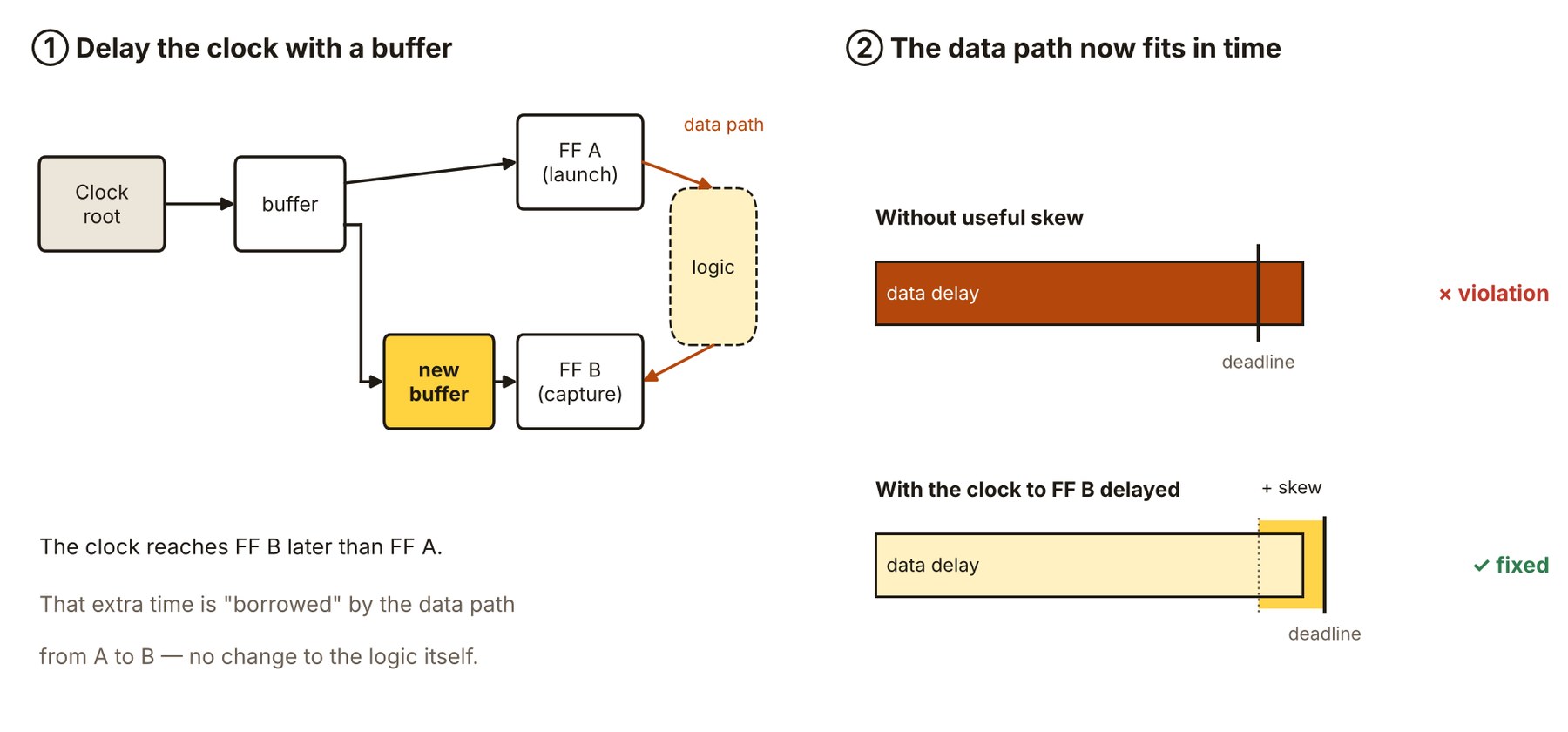
Useful skew is the alternative: instead of changing the logic, we delay the clock at selected flip-flops by inserting or resizing buffers in the clock tree, so a late clock “borrows” time from the next path. The catch: every change moves many paths at once, it has to work for setup time at the slow (SS) corner and hold time at the fast (FF) corner together, extra buffers cost area, and the program must finish within 10 minutes on designs with up to about a million flip-flops.
How our approach evolved
We gave a progress report every few weeks, and each round of results changed the design.
- May 2026 Dynamic programming on the clock tree. We adapted the classic Van Ginneken buffer-insertion algorithm to two timing corners, tracking delay and area per option and keeping only Pareto-optimal states.
- Jun 2026 Target scheduling + bounded DP. We split the problem: first compute the ideal clock arrival time of every flip-flop as a longest-path problem on two constraint graphs (solved with SPFA, a fast Bellman–Ford), then use a bottom-up DP to make the tree match those targets. Because the contest's score weights were hidden, we picked the final tree by scenario voting — a Borda count over several plausible weightings.
- Jul 2026 The DP hit a wall. Alpha tests showed that averaging targets inside each subtree threw away per-flip-flop information, and the SS corner dominated the score. We moved to a greedy search that repairs critical paths directly, with incremental slack updates.
- Aug 2026 Smallest tree + greedy refinement. We started every run from the smallest legal clock tree and built the greedy post-optimizer that became the final stage of our submission. We also tried a force-directed ("spring") model for target arrival times, but replaced it before the final submission.
- Nov 2026 Wire-aware version. An extension proposed by our advisor's lab: every clock wire now adds delay (see below).
The final pipeline
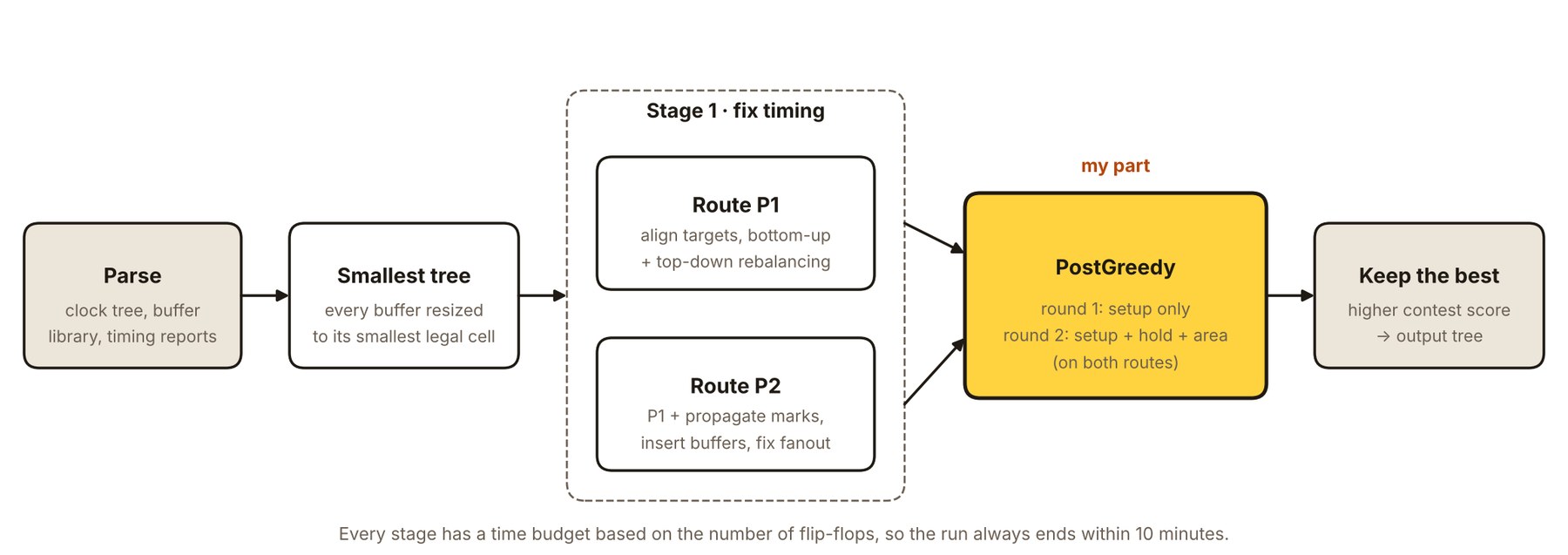
- Start from the smallest legal tree. Every buffer is first resized to its smallest legal size. This reverses the obvious instinct to add buffers everywhere, and is a big reason the final area is so low.
- Stage 1 — fix timing. Align the target clock arrival of all flip-flops, then rebalance buffer delays with a bottom-up and a top-down pass. For flip-flops that still violate setup time, mark them, propagate the mark along their timing paths until it converges, and insert new buffers in front of them. A repair pass then fixes any fanout violations the insertions created.
- Stage 2 — PostGreedy refinement (my part). A greedy local search that only accepts moves that improve the exact contest score — first weighting only setup time, then a mix of setup, hold, and area (details below). It runs on two candidate trees and the better one is kept.
- Time budget by design size. Each stage gets a time budget based on the number of flip-flops, so the program always finishes within 10 minutes and outputs a legal result.
My part: the PostGreedy optimizer
PostGreedy takes the tree from Stage 1 and keeps polishing it until time runs out. What made it work:
- Exact, incremental scoring. It maintains the total buffer area, total negative slack, and a sorted multiset of all negative slacks, so the effect of a move on the real contest score can be computed without re-running timing analysis. A move is committed only if the score strictly improves; otherwise it is rolled back.
- Constant-time subtree checks. Delaying a buffer shifts the clock for its whole subtree, which changes only the paths that cross the subtree boundary. Using DFS entry/exit times, it decides in O(1) whether a flip-flop is inside the subtree and updates only those paths.
- Four kinds of moves:
- remove newly inserted buffers that drive a single sink;
- remove or re-parent split buffers (inserted buffers with two or more sinks) — profiling showed none of our earlier passes touched them, leaving a permanent area overhead;
- resize buffers to smaller cells;
- repair remaining violating paths by inserting the best-sized buffer before the capture flip-flop.
Results
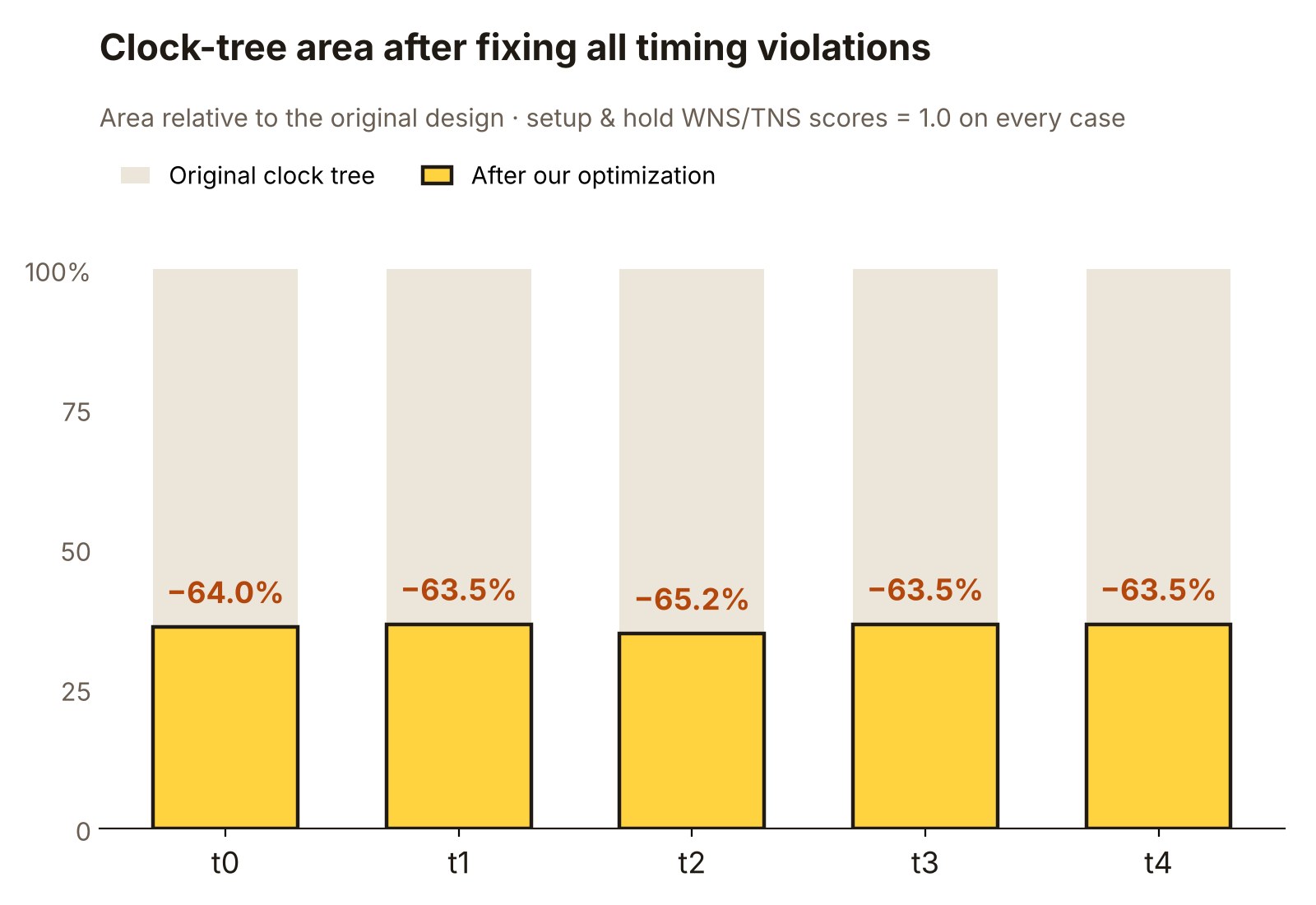
On all five public test cases (t0–t4), the WNS and TNS scores for both setup and hold were 1.0 — every violation fixed — and the clock-tree area dropped by 63.5%–65.2%.
| Case | Setup violations (before) | Setup WNS (before) | Hold WNS (before) | Area before | Area after |
|---|---|---|---|---|---|
| t0 | 18,737 paths | −0.529 | −0.109 | 6,997 | 2,516 (−64.0%) |
| t1 | 4,292 paths | −0.402 | −0.080 | 1,653 | 604 (−63.5%) |
| t2 | 2,156 paths | −0.302 | −0.031 | 980 | 341 (−65.2%) |
| t3 | 6,942 paths | −0.459 | −0.107 | 2,784 | 1,017 (−63.5%) |
| t4 | 32,250 paths | −0.594 | −0.122 | 10,539 | 3,846 (−63.5%) |
After optimization, every case has zero setup and zero hold violations.
Follow-up: when wires have delay
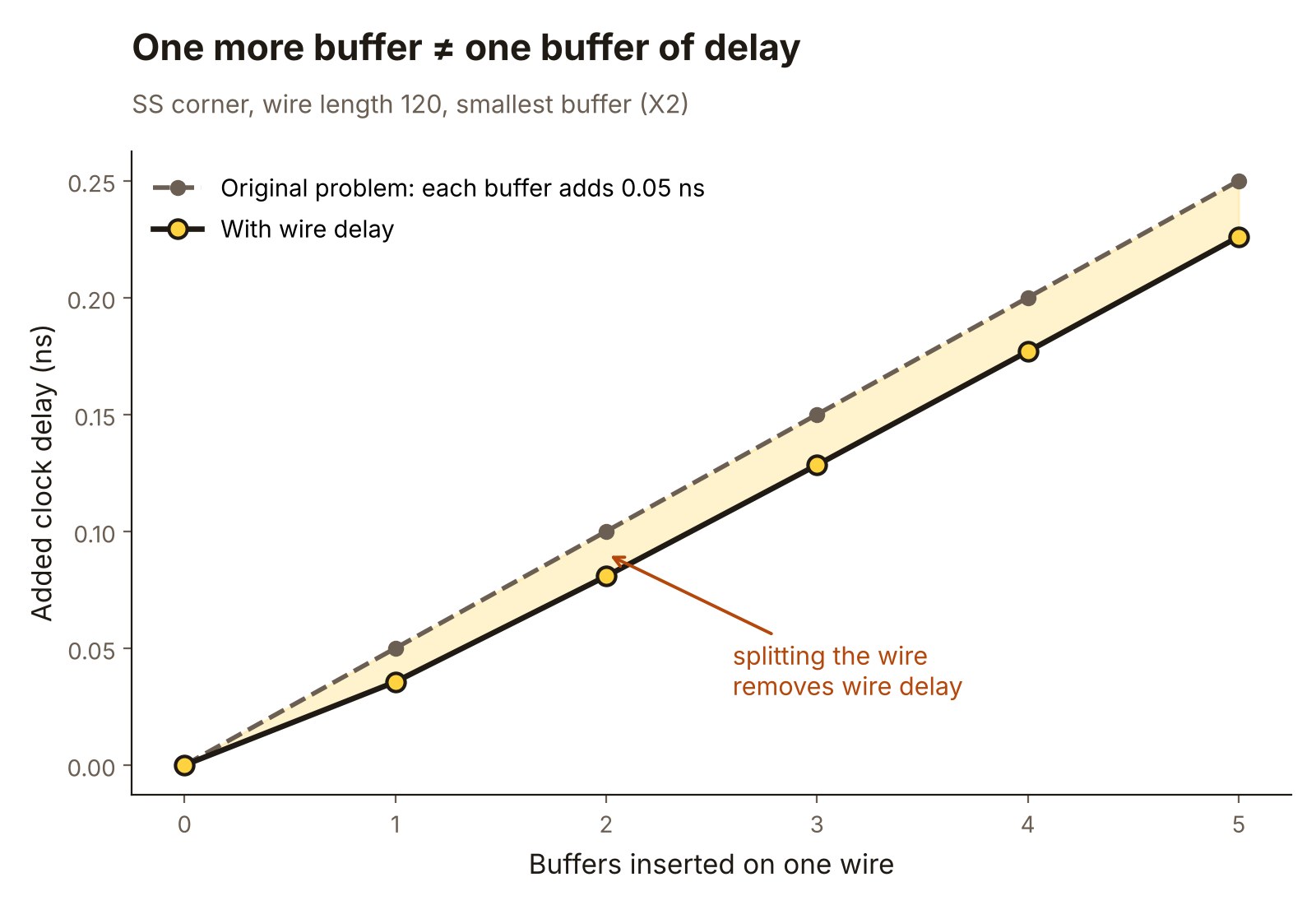
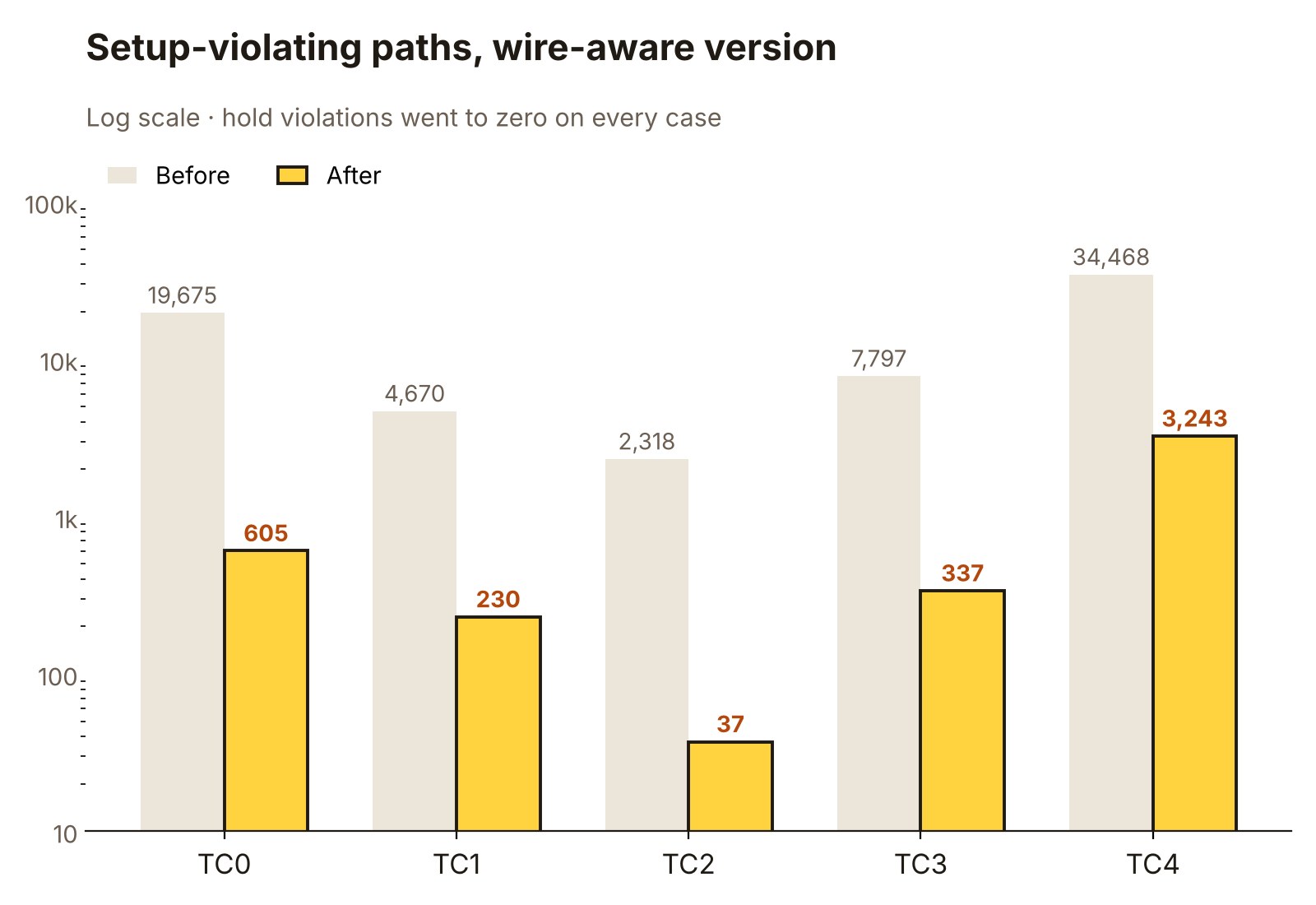
After submitting to the contest, our advisor’s lab gave us a harder extension of the problem: every wire segment in the clock tree now adds delay proportional to its length squared, and inserting a buffer must split a wire so the segment lengths add up to the original. This breaks a basic assumption — one more buffer no longer means one buffer’s worth of delay, because splitting a wire also reduces wire delay. We added wirelength-aware rules for adding, merging, and deleting buffers.
| Before | After | |
|---|---|---|
| Setup violating paths (all 5 cases) | 68,928 | 4,452 (−93.5%) |
| Setup TNS | all 5 cases violated | −99.7% on average |
| Hold violating paths | 850 | 0 |
| Clock-tree area | original trees | −62.8% on average |
All five outputs passed the official legality checker.
What I learned
The biggest lesson was how much the framing mattered. Our first two designs were elegant on paper — DP with Pareto pruning, target scheduling with graph algorithms — but the data told us they lost too much information. Things improved fastest when we changed the starting point (the smallest legal tree) and measured the real score at every step instead of trusting estimates. Building PostGreedy taught me to care about incremental data structures: the difference between recomputing timing and updating it in O(1) is what lets a greedy search explore thousands of moves within the time limit.